
THE DIGITAL PERIMETER
Why Centralized RegTech Is the Critical Defense Against Money Laundering
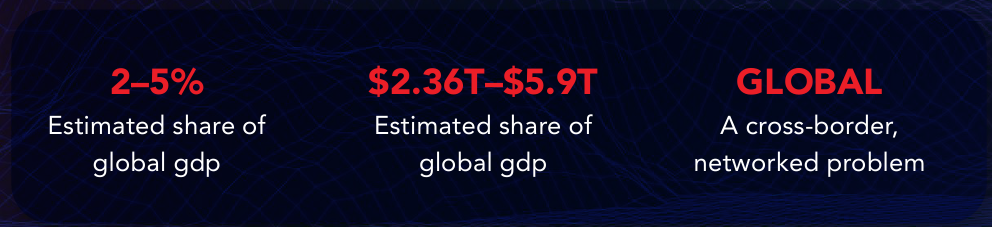
Money laundering is still commonly framed using the UNODC estimate of 2–5% of global GDP. Applied to a global economy approaching USD 118 trillion, that implies an annual volume of roughly USD 2.36 trillion to USD 5.9 trillion. The scale of the problem has changed dramatically, while many compliance benchmarks and monitoring architectures remain rooted in an earlier era.
When the Old Rules Run Out of Road
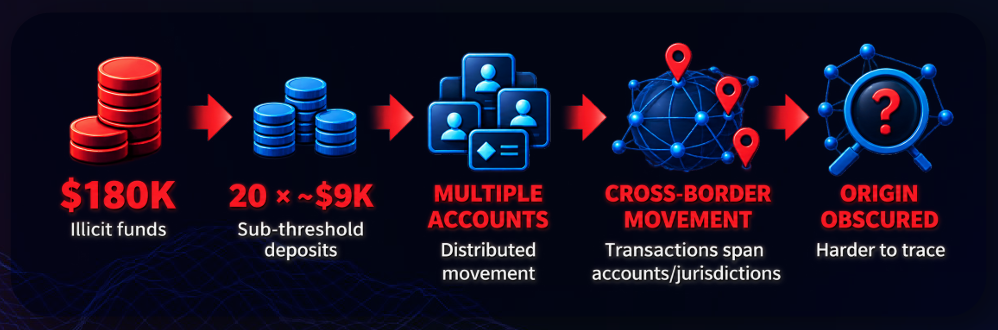
Traditional financial crime compliance assumed suspicious activity would have a recognizable shape: large deposits, unusual wires or patterns that a trained analyst could isolate. The placement layering-integration model still holds conceptually, but criminal execution has evolved. Modern networks structure transactions across mule accounts, exchange houses and jurisdictions to stay below obvious thresholds.
A USD 180,000 sum, for example, can be split into roughly twenty USD 9,000 deposits and then moved across accounts, turning placement into layering before a rules based system sees the full pattern.
This is where legacy monitoring struggles most. False-positive rates in legacy screening systems typically run between 85% and 95%, with sanctions name-matching potentially approaching 99.5%. The operational problem is not just wasted time: excessive noise reduces the attention available for the alerts that genuinely matter

The Regulatory Ground Is Shifting
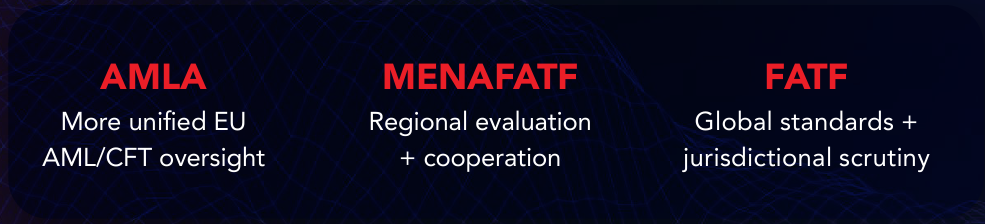
Technology is changing alongside a more centralized regulatory environment. In Europe, AMLA is designed to support more consistent application of AML/CFT rules and closer coordination between national supervisors and Financial Intelligence Units. In the Middle East, MENAFATF has long provided a regional mechanism for mutual evaluation and alignment with FATF standards. The pattern is visible in recent jurisdictional decisions. The UAE was removed from the FATF grey list in February 2024 after a reform programme that followed its March 2022 listing, while Kuwait was added in February 2026 after gaps were identified in its framework. The broader direction is clear: supervisory fragmentation is narrowing, making inconsistent compliance architecture harder to sustain.
The Arms Race Nobody Wanted
The same technologies strengthening compliance are also being used to evade it.
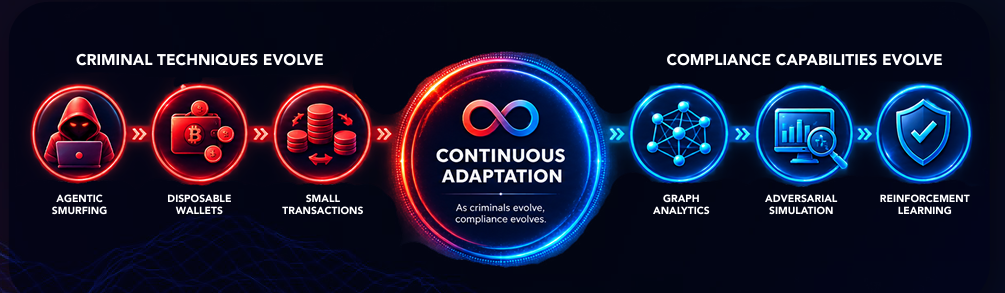
One of the clearest examples is agentic smurfing: autonomous AI agents generating disposable crypto wallets, executing small transactions designed to blend with legitimate DeFi activity and moving value across blockchain bridges.
Generative AI is also expanding synthetic identity fraud through deepfake video, audio and documents designed to defeat biometric KYC controls. In response, forward-looking programs are exploring adversarial simulation and reinforcement-learning approaches that model how criminal techniques and compliance defences evolve against each other.
The Trade-Offs Worth Knowing
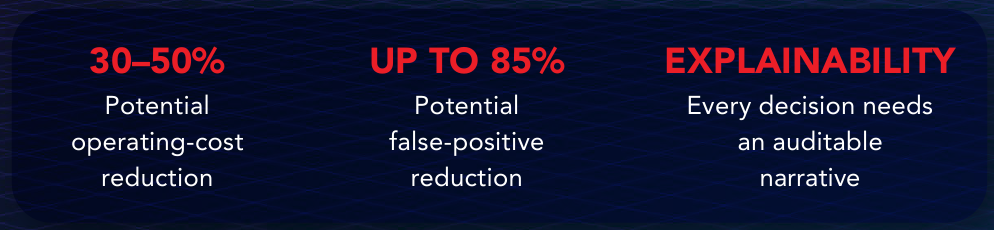
The business case can be compelling: reductions of 30–50% in compliance operating costs, up to 85% in false-positive volumes, and the 50–65% false-positive reductions documented by institutions such as JPMorgan through coordinated AI deployment.
But implementation is not frictionless. Integration with legacy infrastructure, continuous model calibration, privacy requirements around KYB and UBO data and the need for explainable, auditable decisions all increase the governance burden. A high-performing black-box model can still become a regulatory liability if it cannot explain its outputs.
Actionable Strategic Imperatives
The strongest compliance programs are moving from reactive controls to deliberate architecture. The strongest compliance programs are moving from reactive controls to deliberate architecture. Four priorities stand out:
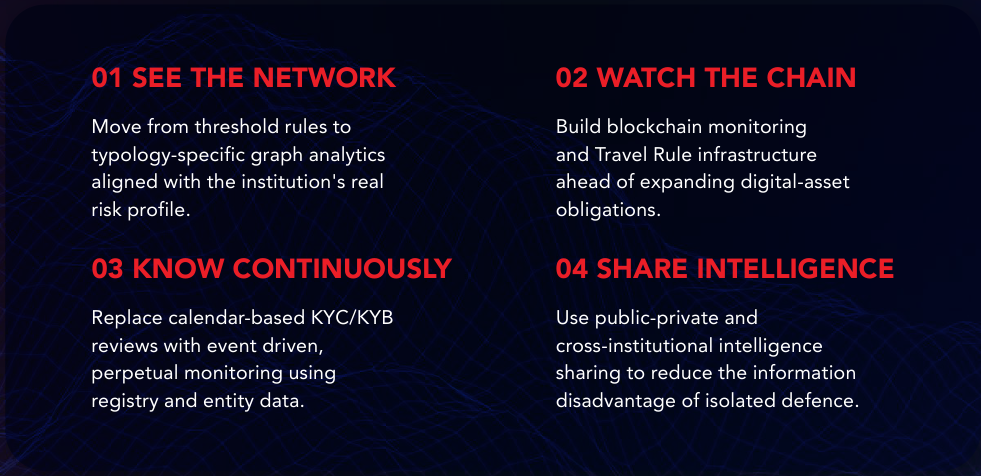
The criminal infrastructure facing financial institutions is increasingly sophisticated, AI-enabled and continuously adaptive. Regulatory architecture is tightening at the same time. Institutions that respond well will be those making architectural choices now: network intelligence over isolated rules, continuous KYC over scheduled reviews, explainable models over opaque scoring and shared intelligence over siloed defence. The perimeter is digital. Whether it holds depends on the architecture behind it.
Like what you see? Share with a friend.